Inner Energy and Physical Energy
Inner energy and physical energy
refer to two very different—but deeply interconnected—dimensions
of human experience.
Physical energy is what we normally think of
in biological or mechanical terms. It comes from the food we eat,
the oxygen we breathe, and the systems in the body that convert
nutrients into movement, heat, and physical output. Muscles
contract, the heart pumps, the brain fires electrical impulses.
This is measurable energy—glucose metabolism, ATP production,
calories burned. It's what lets you walk, talk, lift, and run.
Inner energy, on the other hand, is subtle.
It’s not just physical stamina or fuel—it’s the felt sense of
aliveness, vitality, and flow within your body and mind. You can
sit still and not move a muscle, yet still feel energized—or
drained. Inner energy includes emotional intensity, mental
clarity, spiritual openness, and the general quality of your
being. In Eastern systems like yoga and Chinese medicine,
this is called prana, chi, or
life force.
Michael A. Singer and other spiritual teachers point to inner
energy as what you feel moving inside you when something stirs
your heart, when you fall in love, or when you’re deeply moved by
beauty or fear. It's the rush of joy, the heaviness of grief, the
expansion of peace. You can be well-fed and well-rested (with
plenty of physical energy), yet still feel numb or
lifeless—meaning your inner energy is blocked or depleted.
From a scientific point of view, inner energy is harder to
define. It may not have a calorie count or a voltage, but it
clearly affects our nervous system, hormones, and brain activity.
Practices like meditation, breathwork, and emotional release often
increase this sense of vitality—even though they use very little
physical energy. Inner energy influences posture, expression,
motivation, and our connection to others and to life itself.
One way to see the difference is this: You can charge a
phone (physical energy), but the quality of the call—the clarity,
the connection, the tone—that's like inner energy. One keeps the
system running; the other determines what it feels like
to be alive within it.
The Chakras
The chakra system is a spiritual framework that describes seven
main energy centers within the body, each associated with
particular emotions, psychological patterns, and aspects of
personal growth. Though rooted in ancient Eastern traditions, the
chakra model shares surprising parallels with modern psychology,
especially in how human development, emotional health, and
self-awareness are understood.
1. The Root Chakra (Fear)
The root chakra (Muladhara), located at the
base of the spine, governs safety, survival, and our sense of
being grounded in the world. Emotionally, it relates to fear,
insecurity, and trust. When balanced, it gives a sense of
stability and confidence in life’s foundations—shelter, food, and
belonging. In psychology, this mirrors Erik Erikson’s first stage
of development: trust vs. mistrust. Early childhood experiences of
safety or danger shape whether we feel secure or threatened in the
world. A blocked root chakra might express as chronic anxiety,
hypervigilance, or obsessive concern with money and security.
2. The Sacral Chakra (Sex)
The sacral chakra (Svadhisthana), located in
the lower abdomen, governs pleasure, desire, creativity, and
sexuality. Its emotional realm includes guilt, emotional fluidity,
and the capacity for joy. A balanced sacral chakra allows for
healthy emotional expression, intimacy, and the enjoyment of
life’s pleasures. In psychological terms, this connects to issues
of emotional regulation, sexual identity, and interpersonal
bonding. Trauma, shame, or emotional suppression in this area can
manifest as numbness, codependency, or addictive behavior—areas
that are deeply explored in psychodynamic and attachment theories.
Here is a link to the Mystery of Sex from
viewpoint of Michael A. Singer.
3. The Solar Plexus Chakra (Power)
The solar plexus chakra (Manipura), found
above the navel, represents personal power, autonomy, and will.
Its associated emotions include anger, confidence, and shame. When
balanced, we feel capable, purposeful, and resilient. In Western
psychology, this parallels the development of ego strength and
self-esteem. Cognitive-behavioral models often address negative
core beliefs that damage this center, such as “I am weak” or “I’m
not good enough.” Unbalanced, this chakra may express as power
struggles, low confidence, or controlling behavior—echoing
psychological struggles with assertiveness and self-worth.
4. The Heart Chakra (Love)
The heart chakra (Anahata), located at the
center of the chest, governs love, compassion, forgiveness, and
emotional connection. Its emotions include grief, empathy, joy,
and sorrow. When this chakra is open, we feel a deep connection to
others, and we can give and receive love without conditions. In
psychology, this resonates with emotional intelligence, empathy,
and the capacity for secure attachment. When wounded, we may
struggle with heartbreak, isolation, or fear of vulnerability.
Therapy often aims to reopen the heart after loss or betrayal,
restoring the ability to trust and care deeply again.
5. The Throat Chakra (Knowledge)
The throat chakra (Vishuddha), located in the
throat, relates to communication, truth, and authentic expression.
Emotionally, it connects to fear of speaking, repression, and
dishonesty. A healthy throat chakra allows a person to speak
clearly and truthfully without aggression or fear. In
psychological terms, it aligns with assertiveness training,
healthy boundaries, and the development of a coherent
self-narrative. When blocked, this chakra may cause someone to
stay silent when they should speak or to speak defensively or
manipulatively—symptoms often addressed in interpersonal and
trauma-focused therapies.
6. The Third Eye Chakra (Intuition)
The third eye chakra (Ajna), situated between
the eyebrows, represents intuition, insight, imagination, and
inner wisdom. Its emotional tone is subtle—more about clarity than
feeling. When clear, this chakra allows one to see past illusions,
integrate unconscious material, and develop a strong inner
compass. In psychology, it is closely tied to metacognition—the
ability to observe one's own thoughts—as well as Jung’s concept of
individuation, where the unconscious is made conscious through
insight. An imbalanced third eye may show up as rigid thinking,
confusion, denial, or over-reliance on intellect at the expense of
deeper wisdom.
7. The Crown Chakra (Spiritual)
The crown chakra (Sahasrara), located at the
top of the head, is associated with transcendence, spiritual
connection, and a sense of unity with all things. Its emotional
state is often described as bliss, peace, or awe. When this chakra
is active, one feels guided by something greater than the
individual self. In psychology, particularly transpersonal
psychology, this resembles peak experiences, flow states, and
self-transcendence. Abraham Maslow placed self-actualization and
self-transcendence at the top of his hierarchy of needs. A blocked
crown chakra may appear as spiritual emptiness, cynicism, or
existential despair.
Each chakra represents both an emotional tone and a stage of
psychological development. What is remarkable is how closely these
ancient energy centers reflect the insights of modern therapy.
Both systems acknowledge that healing requires not only insight
but integration—bringing awareness to blocked areas, releasing
trapped emotions, and restoring a balanced flow of energy.
Ultimately, chakras and psychology are two languages describing
the same inner reality. One speaks in the terms of energy and
spirit, the other in the language of cognition and emotion. But
both point toward the same goal: wholeness, clarity, and the
awakening of one’s full human potential.
8. Proposed Sleep Chakra (Rest)
I invented this chakra because sleep and relaxation is important.
This chakra calms down the body down to promote meditation,
relaxation, and sleep. It is located in the brain stem. When any of the
otherl chakras are activated there is
an corresponding increase in inner energy. But this chakra
reduces the inner energy to promote sleep and
relaxation. . It is associated with a parasympathetic nervous
system. Blocked energy in this chakra may cause insomnia.
Balancing the Chakras
Balancing the chakras involves integrating practices that harmonize
the mind and body. Meditation and visualization are powerful tools
that allow us to focus on specific chakras, helping to release
blockages and encourage a smooth flow of energy. When combined with
breathwork techniques, such as deep breathing or pranayama, the
process becomes even more effective in reducing tension and enhancing
focus. To release a samskara, tune into the blocking
energy, sadness, fear and other bad emotions. Let it build, and then
picture the energy being released down the arms and out the fingers.
Let it flow down our legs and out our toes as well.
Meditation and Mindfulness
Meditation is a practice of training your mind to achieve clarity,
calmness, and inner awareness. It often involves focusing on a single
point of attention, like your breath, a mantra, or a visualization, to
quiet the mind and foster a sense of peace.
To meditate, find a quiet space, sit comfortably, and close your
eyes. Focus on your breathing or a chosen anchor, and if your mind
drifts, gently return your attention to it without judgment,
cultivating a sense of presence and stillness. Just observe what is
going on around without thinking about it or doing something about.
Just observe.
Mindfulness and meditation are closely related but serve slightly
different purposes and can be practiced independently or together
Mindfulness is the act of being fully present in the moment, paying
attention to your thoughts, feelings, and surroundings without
judgment. It’s a way of living that can be applied to any activity,
such as eating, walking, or even washing dishes.
Meditation, on the other hand, is a structured practice designed to
train the mind, often using mindfulness as a technique. It typically
involves setting aside specific time to sit quietly, focus, and
cultivate inner awareness or stillness.
In essence, mindfulness is a state of being, while meditation is a
dedicated practice to nurture that state. Mindfulness can be practiced
throughout your day, while meditation often requires intentional
effort and a specific setting.
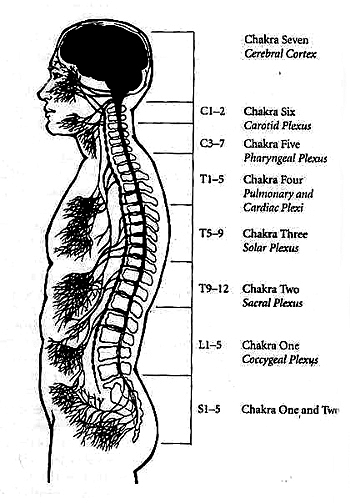
The Spine and the Chakras
The vertebrae in the spine provide the physical structure for the
body and protect the spinal cord, while the chakras are part of the
subtle energy system in spiritual and metaphysical traditions. Each
chakra is associated with a specific region of the spine and the body,
and these regions correspond to the physical nerves, organs, and
systems connected to that area.
The vertebrae in the spine are named based on their location within
the spinal column. The naming system uses a letter to denote the
region and a number to indicate the position of the vertebra within
that region, starting from the top of the spine and moving downward.
The cervical vertebrae (C1 to C7) are located in the neck region.
The "C" stands for cervical, and the numbers 1 through 7 indicate the
position of each vertebra from the top downward. For example, C1, also
known as the atlas, supports the skull and allows nodding motions,
while C2, the axis, enables head rotation.
The thoracic vertebrae (T1 to T12) are found in the upper and
mid-back, where they connect to the ribs. The "T" stands for thoracic,
and the numbers 1 through 12 correspond to each vertebra from the top
of the thoracic region downward. For instance, T1 is the first
thoracic vertebra near the neck, and T12 is the last thoracic vertebra
just above the lumbar region.
The lumbar vertebrae (L1 to L5) are located in the lower back. The
"L" stands for lumbar, and the numbers 1 through 5 indicate the
position of the vertebrae from top to bottom in this region. L1 is the
first lumbar vertebra, and L5 is the last, which sits above the
sacrum.
The sacral vertebrae (S1 to S5) are fused to form the sacrum, a
triangular bone at the base of the spine. The "S" stands for sacral,
and the numbers 1 through 5 indicate the individual segments of the
sacrum. S1 is the uppermost part of the sacrum.
The coccygeal vertebrae (Coc1 to Coc4) make up the coccyx, or
tailbone. These are small, fused vertebrae. The "Coc" stands for
coccygeal, and the numbers 1 through 4 indicate the segments of the
coccyx.
This naming system provides a clear and precise way to identify and
refer to specific parts of the spine for medical, anatomical, and
metaphysical discussions.
Energy_and_Energy_Blockage"
Our energy, often referred to as life energy or vitality, is a
dynamic interplay between physical energy and the more subtle
emotional, mental, and spiritual energies that define our experience
of life. Physical energy comes from the body, generated through
processes like metabolism, where food and oxygen are converted into
fuel for our cells. This energy supports our physical actions, from
movement to maintaining essential bodily functions. At the same time,
our emotional and mental states can influence this physical energy.
For example, feelings of excitement or joy often seem to create a
surge of energy, while stress or sadness can leave us feeling drained.
This connection suggests that our energy is not just a physical
phenomenon but also deeply tied to our inner world.
Our energy is generated and sustained by several factors, including
our physical health, mental clarity, emotional balance, and spiritual
connection. However, it can become blocked through unresolved
emotions, negative thought patterns, or physical tension. According to
Michael A. Singer and similar teachings, these blockages often
manifest as resistance to life experiences—when we suppress or cling
to certain emotions or thoughts, the natural flow of energy is
disrupted. For example, anger or fear that we hold onto can create
tension in both the body and mind, leading to fatigue or a sense of
being stuck. To unblock energy, it’s essential to release these
resistances, allowing emotions and experiences to flow through us
without clinging or suppression. This openness not only restores
vitality but also aligns us with a sense of inner harmony and balance,
where energy flows freely and supports our physical, emotional, and
spiritual well-being.
Removing Emotional Blockages and Generating Energy
Removing blockages and restoring energy involves a combination of
mindfulness, physical care, and emotional release. Practices like
meditation and mindfulness help us become aware of internal
resistance, allowing us to observe and release it without suppression
or clinging. For example, when uncomfortable emotions arise, simply
acknowledging them and letting them flow naturally can dissolve the
tension they create. Similarly, physical movement, such as yoga or
stretching, combined with deep, intentional breathing, can help
release tension stored in the body and promote the free flow of
energy.
Letting go of resistance is key to restoring vitality. Blockages
often form when we cling to positive experiences or resist negative
ones, creating stagnation in our energy. By relaxing into discomfort
and accepting life's natural flow, we allow these blockages to
resolve. Maintaining physical health through proper sleep, nutrition,
and hydration further supports this process, as the body’s vitality is
intrinsically linked to emotional and mental well-being. Practices
like gratitude and visualization can also shift focus from tension to
openness, fostering a deeper sense of balance and energy. Through
consistent application of these methods, we cultivate a state of
openness and vitality that allows energy to flow freely within us.
There are many great authors who have contributed to the process of
becoming a person who can be in the presence of God. John C. Robinson
speaks of the process in his book Ordinary Enlightenment
(2000)
The Sympathetic and Parasympathetic Nervous
Systems
The human nervous system is beautifully designed to balance states
of awareness and relaxation, achieved through the interplay of two
systems: the sympathetic and parasympathetic divisions of the
autonomic nervous system, which is part of the peripheral nervous
system.
The Sympathetic Nervous System
(Prepares for Fight or Flight)
Sympathetic system is the driving force behind
heightened awareness and alertness. Often referred to as the "fight or
flight" system, it prepares the body to respond to stress or
challenges. When activated, it increases heart rate, sharpens focus,
and boosts energy levels, directing resources to muscles and the
brain. This state of heightened readiness allows us to react swiftly
and effectively to external stimuli, making us keenly aware of our
environment.
The sympathetic nervous system (SNS), responsible for the "fight or
flight" response, uses specific chemicals to communicate and enact
changes in the body. These chemicals are primarily neurotransmitters
and hormones. Here are the key ones:
1. Norepinephrine (Noradrenaline)
- Role: Acts as the primary neurotransmitter of
the sympathetic nervous system.
- Function:
- Released by sympathetic nerve endings (postganglionic
neurons) to target organs.
- Increases heart rate, blood pressure, and breathing rate.
- Promotes energy mobilization by stimulating glucose
release and fatty acid breakdown.
2. Epinephrine (Adrenaline)
- Role: A hormone released by the adrenal
medulla (part of the adrenal glands).
- Function:
- Works alongside norepinephrine to amplify the "fight or
flight" response.
- Increases blood flow to muscles and brain, dilates
airways, and boosts alertness.
- Enhances the release of stored energy, preparing the body
for action.
3. Acetylcholine (ACh)
- Role: A neurotransmitter involved in
preganglionic communication within the sympathetic nervous system.
- Function:
- Released by preganglionic neurons to stimulate
postganglionic neurons.
- Initiates the cascade that leads to the release of
norepinephrine or epinephrine.
4. Cortisol
- Role: A hormone from the adrenal cortex that
supports the SNS during prolonged stress.
- Function:
- Enhances the effects of epinephrine and norepinephrine.
- Helps regulate metabolism to sustain energy availability.
5. Dopamine
- Role: A precursor to norepinephrine and
epinephrine, and also acts as a neurotransmitter in some
sympathetic pathways.
- Function:
- In specific contexts, dopamine influences vascular tone
and kidney function, contributing to the SNS response.
These chemicals collectively drive the body's acute stress
response, increasing alertness, redirecting blood flow to essential
muscles, and preparing the body to respond to immediate challenges.
Parasympathetic system is the driving force behind
relaxation and recovery. Known as the "rest and digest" system, it
helps the body unwind after periods of stress or activity. It slows
the heart rate, enhances digestion, and supports restorative processes
like healing and sleep. By fostering calmness and rejuvenation, this
system is essential for maintaining balance and long-term well-being.
Together, these systems work dynamically to help you navigate the
world. The sympathetic system heightens your awareness when needed,
while the parasympathetic system ensures you can relax, recover, and
sustain a state of inner peace. This balance is crucial for both
physical and emotional health, supporting a life that is both vibrant
and centered.
The Parasympathetic Nervous System
(Prepares for Relaxation)
The parasympathetic nervous system (PNS), responsible for the "rest
and digest" response, uses specific neurotransmitters and chemicals to
promote relaxation, restore energy, and support bodily maintenance
functions. Here are the key chemicals associated with the
parasympathetic system:
1. Acetylcholine (ACh)
- Primary neurotransmitter of the parasympathetic
nervous system.
- Role: Facilitates communication between
nerves and target organs (e.g., heart, lungs, digestive system).
- Functions:
- Decreases heart rate and promotes relaxation.
- Stimulates digestive processes by increasing secretion of
enzymes and digestive fluids.
- Enhances salivation and tear production.
- Contracts smooth muscles in the gastrointestinal tract and
bladder.
2. Nitric Oxide (NO)
- Role: A signaling molecule that modulates
certain parasympathetic functions.
- Functions:
- Promotes vasodilation (widening of blood vessels) to
increase blood flow.
- Helps relax smooth muscles, contributing to processes like
digestion and bladder control.
3. Vasoactive Intestinal Peptide (VIP)
- Role: A neuropeptide co-released with
acetylcholine in some parasympathetic pathways.
- Functions:
- Stimulates secretion of digestive juices.
- Relaxes smooth muscles in the gastrointestinal and
respiratory tracts.
- Enhances blood flow to the digestive organs.
4. Gastrin-Releasing Peptide (GRP)
- Role: A neurotransmitter in parasympathetic
regulation of the digestive system.
- Functions:
- Stimulates the release of gastrin, a hormone that
increases stomach acid production for digestion.
5. Serotonin (5-HT)
- Role: While not exclusive to the PNS,
serotonin plays a crucial role in the gut, where parasympathetic
activity dominates.
- Functions:
- Facilitates smooth muscle contraction in the
gastrointestinal tract.
- Regulates bowel movements and digestion.
These chemicals work together to ensure the parasympathetic nervous
system can slow down and restore the body after periods of stress or
activity. They promote relaxation, energy conservation, and efficient
organ function, creating a state of balance essential for health and
well-being.
